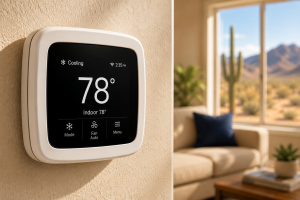
In Arizona, your thermostat does more than set the temperature. It tells your air conditioner when to start, when to stop, and how long to run.
When your thermostat is set correctly, placed properly, and working with your system, it can help your home stay comfortable without forcing your AC to work harder than necessary. But when your thermostat is set too low, installed in the wrong spot, outdated, or not reading the home accurately, it can fight against your comfort and your energy bill.
For homeowners in Phoenix, Scottsdale, Mesa, Chandler, Gilbert, Glendale, Tucson, Peoria, Tempe, Queen Creek, Buckeye, Surprise, Avondale, and Casa Grande, thermostat settings matter even more during extreme summer heat.
When it is 110 degrees outside, it is tempting to drop the thermostat to 70 or lower and hope the house cools faster. The problem is that setting the thermostat extremely low does not cool your home faster. It usually just makes the AC run longer.
That extra run time can increase energy use and put more stress on your system. During Arizona heat, your AC is already working hard. A thermostat setting that is too aggressive can make the system run almost nonstop.
Instead of constantly lowering the thermostat, choose a realistic setting that keeps your home comfortable without overworking the system. Many Arizona homeowners use a higher setting during the day and adjust based on comfort, insulation, sun exposure, and whether people are home.
Thermostat placement can make a big difference.
If your thermostat is in direct sunlight, near a window, close to a lamp, near a TV, by a kitchen, or too close to a supply vent, it may not be reading your home correctly. That can cause your AC to run too long or shut off too soon.
For example, a thermostat near a sunny window may think the home is hotter than it really is. A thermostat near a cold supply vent may think the home is cooler than it really is. Either way, the result can be poor comfort, uneven cooling, and wasted energy.
Your thermostat should be in a central area where it can read the home’s average temperature more accurately.
If your thermostat stays at the same temperature all day and night, it may not be helping your system work efficiently.
A programmable or smart thermostat can help adjust temperatures based on when you are home, away, or asleep. That can be especially helpful for Arizona homeowners with changing schedules, time-of-use energy plans, second homes, or long workdays away from the house.
The goal is not to make your home uncomfortable. The goal is to avoid cooling an empty home the same way you cool it when everyone is home.
Older thermostats can still work, but they may not offer the accuracy, scheduling, or control that newer models provide. Some older thermostats can also become less reliable over time.
A smart thermostat can help homeowners adjust settings from a phone, create cooling schedules, track usage patterns, and manage comfort more easily. This can be useful in Arizona homes where the afternoon heat hits hard or where families want better control while they are away.
A smart thermostat is not always the answer by itself, but when installed correctly and paired with a properly running AC system, it can be a helpful upgrade.
Most thermostats have fan settings like “auto” and “on.”
When the fan is set to “auto,” it usually runs only when the AC is actively cooling. When the fan is set to “on,” it may run continuously, even when the system is not cooling.
In some cases, running the fan can help circulate air. But for many homeowners, leaving the fan on all the time can increase energy use and may not solve the real comfort issue. If you have hot rooms, weak airflow, or uneven cooling, the better move is to have the system checked.
Sometimes the thermostat is not the real issue. It may just be where the problem shows up.
If your thermostat says the AC is cooling but your home still feels warm, your system may have another issue. Common causes include a dirty filter, blocked airflow, dirty coils, low refrigerant, duct problems, or an aging AC system that is struggling in the heat.
Before assuming the thermostat is broken, check the basics:
Make sure the thermostat is set to cool
Make sure the set temperature is below the indoor temperature
Replace the batteries if needed
Check the air filter
Make sure vents are open and unblocked
Confirm the breaker has not tripped
If those items look fine and the home still will not cool, it may be time to schedule service.
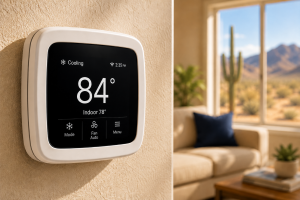
Your thermostat may be part of the problem if you notice:
The AC runs constantly
The home never reaches the set temperature
Some rooms are much hotter than others
The thermostat reading seems inaccurate
The system turns on and off too often
Your energy bill is higher than expected
The screen is blank or unresponsive
The AC does not start when it should
The thermostat is near sunlight, vents, windows, or heat sources
If these warning signs happen during an Arizona summer, do not ignore them. A small thermostat issue can quickly become a major comfort problem.
Start with simple changes.
Avoid setting the thermostat extremely low. It will not cool your home faster and can force the AC to run longer.
Check the thermostat location. If it is near sunlight, electronics, windows, vents, appliances, or a warm hallway, it may be giving your system bad information.
Review your schedule. If nobody is home during the day, a programmable or smart thermostat may help reduce unnecessary cooling.
Pay attention to airflow. If the thermostat is set correctly but the home still feels warm, the problem may be with the AC system, not the thermostat.
Schedule professional service if the system is short cycling, blowing warm air, running constantly, or failing to cool the home.
Arizona homes can have very different cooling needs. A two-story home in Gilbert may struggle with upstairs heat. A west-facing home in Glendale may heat up in the afternoon. A home in Scottsdale or Paradise Valley may have larger windows and more sun exposure. Tucson and Casa Grande homeowners may deal with long stretches of dry heat and dust.
Your thermostat strategy should match your home, not just a generic number.
If your home has hot rooms, uneven temperatures, or a thermostat that never seems to match how the house feels, Chas Roberts can help inspect the system and recommend the next step.
If your thermostat is not responding, reading the wrong temperature, causing short cycling, or failing to keep your home comfortable, call Chas Roberts.
Our team can help determine whether the issue is the thermostat, the AC system, airflow, wiring, or another cooling problem. From thermostat troubleshooting to AC repair, maintenance, and smart thermostat options, Chas Roberts helps Arizona homeowners stay comfortable through the heat.
Your thermostat should help your AC work smarter, not harder. But if it is set too low, placed in the wrong location, outdated, or masking a larger AC issue, it may be fighting your comfort.
In Arizona heat, small thermostat mistakes can make a big difference. The right settings, better placement, clean airflow, and professional support can help your home stay cooler and more comfortable.
Think your thermostat is fighting your comfort? Schedule AC service with Chas Roberts today and let our team help your home stay cool through Arizona heat.